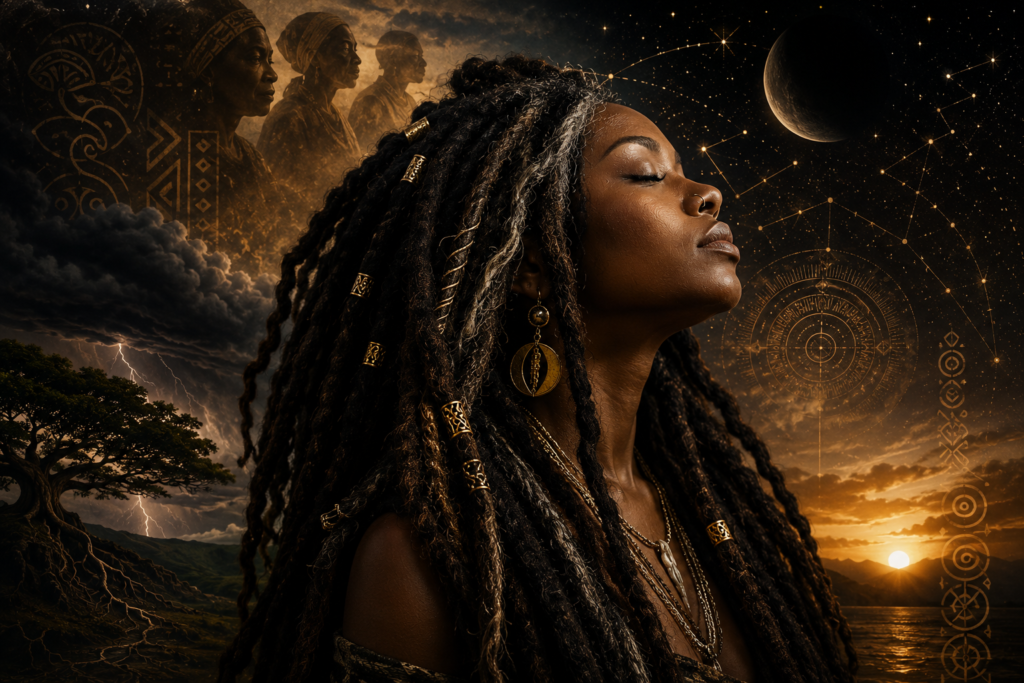
I know of people who have cut their locs only to reattach them years later. I’ve also known people who kept their locs for years and then decided they no longer wanted the energy of who they were when they wore them attached to who they are now.
It is even common for someone to attach a loc from a deceased loved one as a way of carrying a piece of them forward. A tangible connection. A remembrance. A continuation.
They say gray hair is wisdom. They say mature locs are wisdom made visible. Yet doctors tell us hair is simply dead protein. Biologists tell us genetics determine texture, density, and growth patterns. Science explains the mechanics of hair remarkably well.
But if hair is merely dead cells, why have civilizations across Africa, Asia, the Americas, and the Middle East spent thousands of years treating it as something sacred?
Why did our ancestors place such significance on the crown?
Why did warriors refuse to cut it? Why did spiritual leaders grow it? Why did grieving families preserve it? Why did entire cultures believe the hair on our heads connected us to identity, memory, nature, ancestry, and even the divine?
Perhaps the question isn’t whether our ancestors understood hair scientifically.
Perhaps the question is whether they understood something else that we’ve forgotten.
The Crown
Long before modern beauty standards, many cultures believed the head was the most spiritually significant part of the body.
Among the Yoruba people of West Africa, the concept of Ori refers to more than the physical head. It represents destiny, higher consciousness, and divine purpose. The crown of the head was considered the seat of one’s spiritual identity.
In ancient Egypt, elaborate hairstyles and head coverings often carried social and spiritual significance. Hair was connected to status, identity, and one’s relationship with the divine.
Among Sikhs, uncut hair remains one of the central expressions of faith and acceptance of the Creator’s design.
In Rastafari culture, locs became a visible symbol of covenant, resistance, spirituality, and connection to African identity.
Even among many Indigenous cultures throughout the Americas, long hair was viewed as an extension of self—something deeply connected to identity, wisdom, and one’s relationship with the natural world.
Different cultures. Different languages. Different continents.
Yet the same recurring message emerged:
The crown matters.
Why Hair Was Never Just Hair
Modern science can explain the composition of hair.
Keratin. Follicles. Growth cycles. Melanin.
But science and symbolism have never been enemies.
A wedding ring is metal.
A family photograph is paper.
A military uniform is fabric.
Yet we understand those objects carry meaning beyond their physical materials.
Perhaps that is why hair occupies such a unique place in human history.
Hair grows with us.
It witnesses our transformations.
It remains long after a season of our life has ended.
Maybe that is why so many people feel conflicted when cutting their locs.
Some feel liberated.
Others grieve.
Some preserve them.
Some bury them.
Some reattach them years later.
The physical hair may not contain memory in the scientific sense, but memory certainly becomes attached to it.
A loc becomes a timeline.
A visible archive of who we were while it grew.
Can Hair Hold Energy?
This is where science becomes quiet and culture begins speaking.
Many spiritual traditions teach that hair carries energy, stores experiences, or acts as a conduit between the individual and the universe.
Modern science has not proven these claims.
Yet what fascinates me is how often these beliefs appear throughout history.
Again and again, humanity returned to the idea that hair is connected to awareness.
Connection.
Presence.
Intuition.
Perhaps our ancestors weren’t speaking in scientific language.
Perhaps they were describing experiences they observed but could not measure.
Perhaps they noticed that when people changed their hair, something deeper often changed too.
Identity shifted.
Confidence shifted.
Perspective shifted.
Life shifted.
Maybe the transformation was never in the hair itself.
Maybe the transformation was always within the person.
The Weather Knows Before We Do
One of the most fascinating beliefs surrounding locs involves nature itself.
Many people with locs swear they can sense rain before it arrives.
They talk about feeling changes in moisture, heaviness, texture, or movement.
Science actually supports part of this observation.
Hair responds to humidity.
Before a storm becomes visible, moisture levels in the atmosphere begin changing. Hair absorbs that moisture and reacts.
For centuries, strands of human hair were even used in instruments designed to measure humidity.
But our ancestors often interpreted these experiences differently.
To them, the crown wasn’t simply reacting to weather.
It was communicating with nature.
The wind spoke.
The rain announced itself.
The body listened.
Whether viewed through science or spirituality, the result remains the same:
We are far more connected to our environment than modern life often allows us to remember.
Wisdom Locs
Gray hair has long been associated with wisdom.
Science explains it as reduced melanin production.
Our ancestors saw something more poetic.
They saw experience becoming visible.
Evidence of lessons survived.
Challenges overcome.
Years lived.
The same idea often extends to mature locs.
A fully developed set of locs represents patience.
Commitment.
Time.
Growth.
No one wakes up with wisdom locs.
They are earned.
Just as wisdom itself is earned.
Every stage contributes.
The budding stage.
The awkward stage.
The frizzy stage.
The beautiful stage.
The difficult stage.
The stages we celebrate and the stages we hide.
They all become part of the story.
What If Our Ancestors Were Talking About Something Bigger?
I don’t know whether hair stores energy.
I don’t know whether locs function as spiritual antennas.
I don’t know whether a loved one’s loc can carry a piece of their spirit.
What I do know is this:
Human beings have spent thousands of years assigning meaning to the crown.
Across cultures, hair became associated with wisdom, identity, spirituality, ancestry, nature, and transformation.
Perhaps they were all wrong.
Or perhaps they were describing something real using the language available to them.
Because when I think about locs, I don’t just see hair.
I see patience.
I see heritage.
I see identity.
I see stories.
I see generations.
And maybe that’s why so many people feel something deeper when they touch their crown.
Not because hair is magical.
But because it reminds us of something we’ve always known:
We are connected.
To ourselves.
To those who came before us.
To the earth beneath us.
And to something far greater than we can fully explain.
— The Loc Stone
